
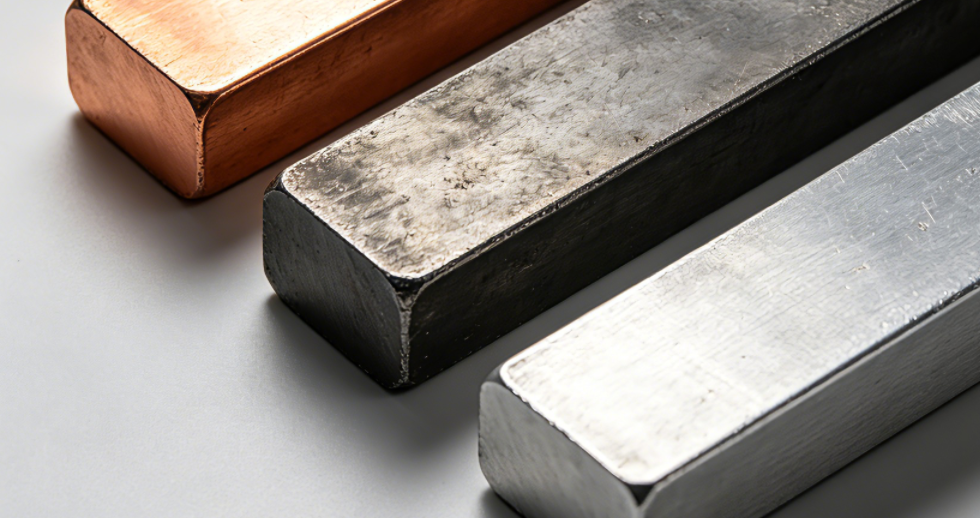
Small-Batch CNC Machining Material Guide
CNC machining technology can indeed handle a very wide range of materials, from various metals to non-metallic materials. Among the metals, there are aluminum alloys, steel, stainless steel, copper, titanium alloys, zinc alloys, magnesium alloys, tungsten steel, etc. For non-metals, there are engineering plastics, composite materials, and other non-metals, etc.
How to Select the Appropriate Materials for Your Project?
When choosing materials, we should make judgments based on the actual application scenarios, which include performance requirements, machining techniques, cost, and post-machining needs. The following details each of these indicators.
Mechanical Performance Requirements: Assess the loads that the parts need to withstand, the temperature range of the working environment, whether corrosion resistance or heat conductivity is required, etc. For example, in scenarios where high strength and high temperature resistance are needed, titanium alloys or stainless steel can be selected; while for applications that are sensitive to weight, aluminum alloys or engineering plastics may be preferred.
Machining Techniques: The cutting difficulty and characteristics of different materials vary. For instance, when machining non-metallic materials (such as certain composite materials, plastics), they may be softer than metal materials, but some are prone to melting and sticking to the cutter, while others are prone to chipping and delamination, requiring adjustments to the machine tool performance and machining parameters.
Cost: The material cost itself is an important factor. Additionally, the machining difficulty also affects the total cost – materials that are difficult to process will consume more tool costs and labor costs.
Post-Machining Requirements: If the parts require additional surface treatments (such as anodizing, electroplating, painting), the suitability of the material also varies. For example, aluminum alloys are very suitable for anodizing.
Introduction to Small-Batch CNC Machining of Metal Materials
Aluminum Alloy
Aluminum alloy is one of the most commonly used metal materials in CNC machining. Among them, the 5xxx/6xxx/7xxx three series are the most frequently used grades. Below, I will introduce some of the commonly used grades.
6061 (Easy to Process, Inexpensive)
The main characteristics of 6061 are excellent comprehensive performance, balanced strength, corrosion resistance and machining performance. Its tensile strength is approximately 310 MPa, yield strength is approximately 276 MPa, and the combination of strength, toughness and corrosion resistance is good.
Moreover, its machining performance is excellent and it is a standard grade for CNC machining. It has low cutting resistance and is easy to achieve high tolerances. The price is convenient. 6061 aluminum alloy also has very good cost-effectiveness and is one of the most economical common choices. The most common surface treatment for this material is anodizing. After treatment, the appearance is very good and is very suitable for applications in automotive parts, bicycle frames, valves, computer parts, general mechanical parts, precision machining, etc.
7075 (High-Strength)
7075 is renowned for its extremely high strength. Its tensile strength can reach 524 MPa, and its yield strength can reach 455 MPa. It is one of the strongest common aluminum alloys. In terms of machining performance, it is slightly lower than 6061, and requires a larger cutting force to wear the tool quickly.
The machining requirements are also higher. In terms of price, the price of 7075 is usually 20%-30% higher than that of 6061. It should be noted that 7075 contains other alloy components, so its corrosion resistance is generally poor. After anodizing, patterns may appear, and more strict process control is required. It is usually applied in aerospace structural components, missile parts, high-end molds, military equipment, top-level bicycle frames, and so on.
2024 (High Temperature)
This material is characterized by high hardness and great strength, with the tensile strength reaching 425-470 MPa. It performs particularly well in high-temperature environments (above 150℃). Its machining performance is similar to 7075, but the price is higher. The only drawback is that its corrosion resistance is relatively poor. Surface coating (such as painting) or aluminum coating protection must be applied to enhance the corrosion resistance before it can be used. Common application scenarios include aircraft fuselages, wing tension components, transportation vehicle parts, propeller elements, and other high-load structural components.
5083 (Corrosion-Resistant)
The main advantage of 5083 is its excellent corrosion resistance, especially in marine environments. Moreover, it has good welding and machining properties. However, 5083 cannot undergo heat treatment and mainly relies on cold work hardening. The price is moderate. Post-machining is mainly for meeting specific appearance requirements, such as sandblasting. It is typically used in shipbuilding (ship hull structures), chemical pressure vessels, transportation tanks, vehicle fuel tanks, and marine facilities, etc.
Steel
45 Steel
45 Steel is the most commonly used medium-carbon quenched and tempered steel. It has good comprehensive mechanical properties, but its quenching rate is relatively low. In terms of machining performance, the cutting machining performance of 45 Steel is relatively good, and it is even better after quenching treatment.
Water quenching is very prone to cracking in small parts, and great attention needs to be paid to process control. The biggest selling point of this material is its price. 45 Steel is one of the commonly used and cost-effective structural steels.
If post-machining is required, small parts are suitable for quenching treatment, while large parts are more suitable for normalizing treatment. Welded parts need to be preheated in advance, and stress relief annealing needs to be carried out after machining.
This material is usually used for machining high-strength moving parts, such as gears, shafts, pistons, connecting rods, etc.
40Cr
After quenching and tempering treatment, 40Cr has excellent comprehensive mechanical properties, low-temperature impact toughness and fatigue strength.
Its quenching property is better than that of 45 steel, and it has good machining performance. However, its weldability is poor, and it is prone to cracking. Preheating is required before welding. Its price is higher than that of 45 steel, but due to the improvement in performance, it has a higher cost-performance ratio in situations requiring higher strength. Various heat treatments such as tempering, high-frequency surface quenching, and carburizing and nitriding can be carried out to meet different requirements. When manufacturing medium-speed and medium-load parts, such as machine tool gears, shafts, and spline shafts, after different heat treatments, they can meet various demands.